
How we compare

A one-page CV has one page and ten sections. Everyone measures the page.

You do not have to take our word for any of this. We checked around seventy tools across fifteen markets — CV builders, document trackers, job boards — reading each one’s own documentation rather than review sites, and every claim below links to where we found it.

Here is what each of them would tell you about your CV, and where they stop.

The same reading, told two ways.

Both panels below describe one recruiter reading your CV once. On the left is everything a page-level tracker can give you. On the right is the same reading, with the sections named.

What a page-level tracker shows you

DocSend, Papermark, PandaDoc — including the free ones.

Page 188s

One bar, because your CV is one page. Time-per-page and total time are the same number here, so this is all you get — and you knew it already.

What you would see here

The same reader, the same CV, the same eighty-eight seconds.

  • Name & contact4s
  • Summary11s
  • Current role38s
  • Previous role22s
  • Skills9s
  • Education3s
  • Projects1s
  • Interests0s
Both panels describe the same 88 seconds. The difference is not accuracy — it is that one of them knows the thing it is timing is called “Current role”, and can therefore tell you to move it up and cut what is under it.

One of those tells you to move your current role up and cut Interests. The other tells you a number.

Five things you could be told about your CV. Most tools stop at three.

Find whatever you use now on this ladder. If it is on rung three — it was opened, by whom, when — you are in good company: that is where most of the world sits, and most job boards give it away free.

  1. 01

    A PDF. No link, no signal at all.

    Teal · Novoresume · Resume Genius · Jobscan · Huntr

  2. 02

    A hosted link, with no analytics behind it.

    Kickresume · Zety · Rezi · FlowCV

  3. 03

    That it was opened — by whom, and when.

    VisualCV · Standard Resume · hh.ru · Naukri · InfoJobs · JobKorea · Bayt

  4. 04

    How long it was open, in total.

    resume.io · Jobfolio

  5. 05

    Which sections were read, for how long, and what was re-read.

    Resumetricx

Whatever you use today is on one of these rungs. We checked around seventy tools across fifteen markets in August 2026 and found nothing else on the fifth.

Why nobody else can just add this.

Telling you which sections were read needs two things at the same time: something that knows what each part of your CV is, and something watching how it was read. Almost every product has exactly one of those.

  • DocSend · Papermark · PandaDoc

    Knows the sections: no

    Measures the reading: yes

    “41 seconds on page 1.” They receive a PDF, so they can count pages — and a CV is page one.

  • Qwilr · Storydoc

    Knows the sections: no

    Measures the reading: yes

    “18 seconds on block 3.” They know their own blocks, but a block is whatever was dragged into it.

  • resume.io · Jobfolio

    Knows the sections: yes

    Measures the reading: no

    “Viewed for 41 seconds.” They built the CV, but measure it as one undivided thing.

  • hh.ru · Naukri · InfoJobs

    Knows the sections: yes

    Measures the reading: no

    “Acme opened it at 14:02.” The open is logged; the reading is not measured at all.

  • Resumetricx

    Knows the sections: yes

    Measures the reading: yes

    “38 seconds on your current role. Education was never reached.”

Two capabilities are needed and almost everyone has one. It is not that the others have not got round to it: a tool holding your finished PDF would first have to work out which part is your experience — the thing applicant tracking systems get wrong often enough to be a running joke.

Why we can

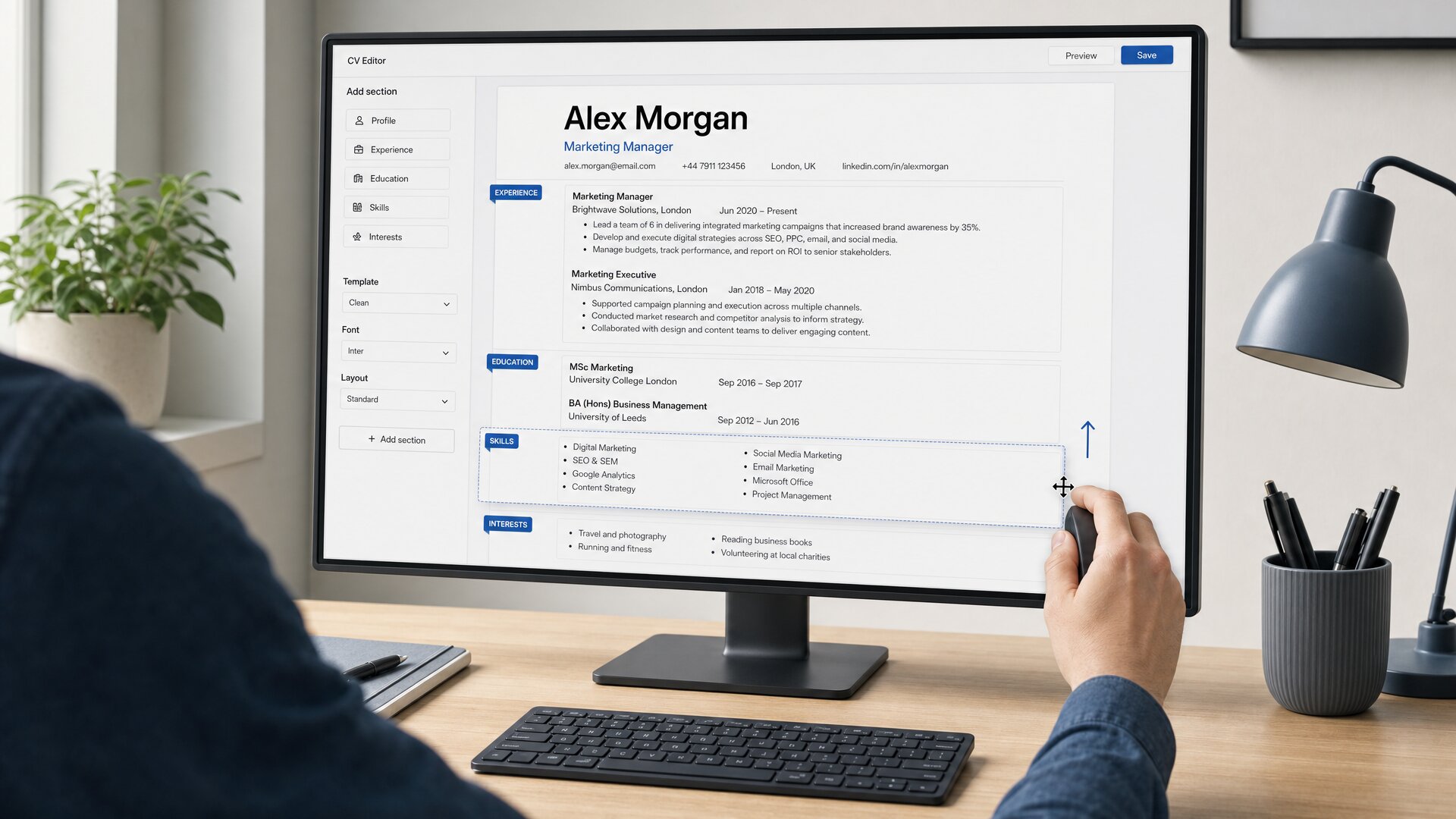
Your CV is built here, so the page itself carries the labels — this block is your experience, that one is your education. When someone reads it, we already know what they were looking at. Nothing has to be guessed.

Why a PDF cannot

Hand a tracking tool a finished file and it sees pages and pixels. To name your sections it would have to read your CV the way an applicant tracking system does — the thing that regularly mistakes your job title for your employer.

If you used one of these instead.

Six alternatives, each quoted from its own documentation with a link to the page it came from. No paraphrasing, no review-site summaries, and nothing here is weaker than the vendor claims it is.

CV builder · the closest alternative

resume.io

“How long someone viewed your resume”, alongside view counts, locations and trend.

What it would tell you

You would learn that someone spent 41 seconds with your CV. Not which 41 seconds. If they read your current role three times and never scrolled to Education, it looks identical to skimming the whole page evenly — and those two readings need completely different fixes.

Drag the card, or use the arrows

1 / 6

resume.io, card 1 of 6

The other half

Four things we would not pick us for.

You are about to spend time and possibly money, so here is the part a comparison page normally leaves out.

  • Prettier templates

    Zety · Enhancv · Canva

    They have better craft and better brand, and if what you want is the best-looking CV on the internet you should use one of them. Ours are good and there are a hundred of them. That is not the same claim.

  • The best-known ATS checker

    Jobscan

    They defined this category and they are very good at it. We run our own check and include it rather than charging extra, but we are not claiming it matches theirs — if ATS scoring is the only thing you need, you do not need us for it.

  • AI writing

    Every builder, since 2023

    The same models behind the same prompts, ours included. Anyone telling you their AI writing is a reason to switch — us or them — is selling you a wrapper.

  • Knowing it was opened

    hh.ru · Naukri · InfoJobs · Papermark · VisualCV

    Free on the job boards in most of the world, and paid on VisualCV. We do it too and we will not pretend it is special. It is also the least useful thing on this page: an open tells you a CV arrived, never what to change.

What is left is one thing, and it is why people pay: which sections of your CV were read, for how long, and which ones someone went back to a second time. We could not find a single product anywhere in the world that tells you that. If you know one, tell us and we will put it on this page.

How to check us

Everything above is checkable, and here is how.

Follow the links

Every quote goes to the vendor’s own help centre, changelog or pricing page. Not a “top ten CV tools” article — those are usually written by whoever is being ranked first.

We left the gaps in

Where we could not confirm something at source, it is not on this page at all. Nothing here is an assumption dressed up as a finding, in either direction.

It has a date on it

August 2026. Two of these could close the gap without inventing anything, and one of them already builds CVs. If that happens we will say so here rather than quietly leave the page up.

See it on your own CV.

Build one, send a link on your next application, and read which sections held them. Ten minutes to build, and the first CV is free; the reading report is what Professional adds.

No card required.